Scientific intelligence
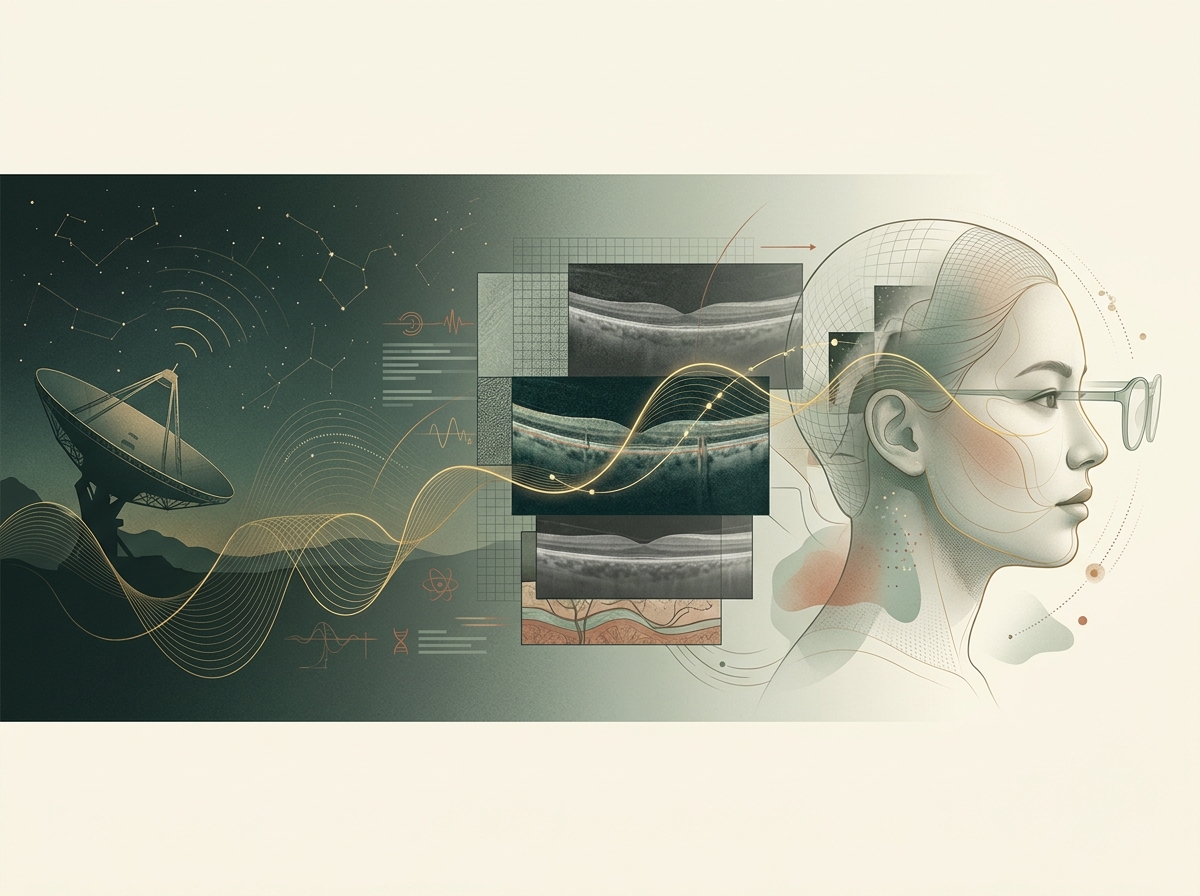
Learning from telescope signals, medical scans, spectral measurements, and uncertainty instead of clean benchmark inputs.
AI for ScienceRobust learningUncertainty
Independent researcher · China / Hong Kong
ZIYANG LI
I build visual intelligence systems that move from pixels to structure, and from structure to scientific or creative action.

01 / Research direction
My work sits at the intersection of computer vision, scientific discovery, and generative systems. The common thread is simple: make difficult visual evidence legible, controllable, and useful.
Learning from telescope signals, medical scans, spectral measurements, and uncertainty instead of clean benchmark inputs.
Reconstructing people, hands, poses, and objects from the messy viewpoints that real users actually produce.
Designing multi-stage creative workflows where agents, assets, and quality control reinforce each other.
The throughline
Whether the input is a radio telescope, an OCT volume, an unconstrained selfie, or a first-person hand video, the hard part is the same: recover the hidden structure without losing the conditions that produced it.
02 / Selected work
Projects are where the research becomes operational: a method, a pipeline, an artifact, and a result someone else can inspect.
Making egocentric hand motion measurable, trainable, and inspectable.
A reproducible research pipeline for first-person hand reconstruction, covering data conversion, training, evaluation, visualization, and error analysis.
High-fidelity reconstruction from unconstrained photo collections. The work connects data rectification, pose-correlated feature aggregation, identity preservation, and multi-garment virtual try-on.
A controllable text-to-film workflow that coordinates world-building, screenwriting, storyboarding, shot generation, quality gates, sound, narration, and post-production.
A computer-vision view of radio-frequency interference in the FAST telescope, combining 24 TB scale pretraining, spatial array priors, generalized masking, and log-space regression.
Unsupervised denoising for stochastic OCT noise through local patch domain transformation, designed for medical images where clean supervision is difficult to obtain.
03 / Publications
Selected work across digital humans, scientific imaging, and intelligent sensing.
Digital humans · multi-view reconstruction
3D heads · identity preservation
Electronic nose · spectral learning
Adaptive convolution · hyperspectral signals
AI for agriculture · attention mechanisms
Edge-friendly sensing · classification
04 / Trajectory
From robotics engineering to scientific AI, medical imaging, digital humans, and creative automation.
Building a multi-agent creative system for end-to-end text-to-film generation.
Digital humans, virtual try-on, OCT registration, unsupervised denoising, and multi-view reconstruction.
Computer vision and scientific intelligence for astronomy, with work spanning detection, generative models, uncertainty, and symbolic regression.
Built a foundation across robotics, perception, deep learning, and applied sensing systems.
05 / Contact
I am interested in research collaborations, ambitious visual intelligence problems, and opportunities where a strong technical system needs a clear point of view.
China / Hong Kong · open to conversations